
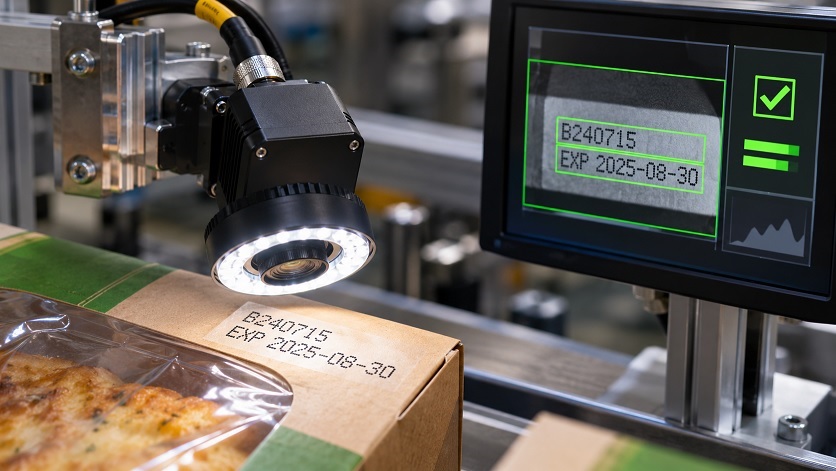
Product labels and expiration dates are essential pieces of information that must be clearly displayed on product packaging. They help consumers identify products, determine their shelf life, and ensure that the items meet their specific needs.
In the food and beverage, pharmaceutical, cosmetics, and other manufacturing industries, errors in label or expiration date printing can lead to serious problems. Information that is blurred, incomplete, or inaccurate may cause products to fail quality control inspections, increase production costs, and even result in customer complaints.
Therefore, companies need to ensure that all information printed on product packaging is clearly readable and accurate before products are distributed.
So, how can manufacturers ensure that product labels and expiration dates remain clear and accurate? Here are several steps that can be implemented during the production process.
Why Is Label and Expiration Date Readability Important?
Product labels provide essential information about product identity, ingredients, usage instructions, and manufacturing details that consumers need to know.
Meanwhile, an expiration date indicates the time limit for using or consuming a product, based on its specific characteristics and applicable requirements.
When this information is not clearly readable, several problems may arise, including:
- Consumers having difficulty identifying product information.
- An increased risk of distribution or product usage errors.
- Products failing quality control inspections.
- Higher costs associated with rework and product replacement.
- Reduced customer confidence in product quality.
To minimize these risks, companies need consistent inspection processes, particularly on high-volume production lines.
1. Choose Printing Technology That Matches the Packaging Material
The first step in ensuring expiration dates are readable is selecting printing technology that suits the characteristics of the packaging material.
Each material has different properties. Plastic, cardboard, glass, and metal packaging may require different printing methods and ink types.
Several technologies commonly used for industrial coding applications include Continuous Inkjet (CIJ), Thermal Inkjet (TIJ), Thermal Transfer Overprinting (TTO), and laser marking.
The selection of printing technology should consider the surface material, production speed, print durability requirements, and character size.
Using the appropriate printing method helps manufacturers produce more consistent batch codes and expiration dates.
2. Ensure Proper Text Placement and Contrast
The readability of printed information depends not only on the quality of the printing machine but also on the position and contrast of the text on the packaging surface.
Text that is too small, printed over folds, or displayed in a color that closely matches the background can be difficult to read.
Therefore, manufacturers should establish a consistent printing area and ensure sufficient contrast between the characters and the packaging background.
The distance between the printing machine and the packaging material is also important to maintain character quality and prevent distortion.
Regular sample inspections can help ensure that printing results consistently meet established quality standards.
3. Conduct Regular Label Inspections
Manual inspection remains an important part of quality control processes in many factories.
Operators typically check label placement, text clarity, and the accuracy of production information.
However, as production volumes increase, manual inspection may face certain limitations.
Conveyor speed, operator fatigue, and differences in inspection accuracy can affect the consistency of inspection results.
Therefore, companies should establish clear inspection procedures, including inspection frequency and the corrective actions required whenever defects or inconsistencies are detected.
4. Utilize a Camera Inspection System
One way to improve the effectiveness of label and expiration date inspections is by implementing a camera inspection system.
This technology uses industrial cameras and image processing software to automatically inspect the visual condition of products.
With the appropriate configuration, the inspection system can be used to detect:
- Missing or improperly attached labels.
- Incorrect label positioning.
- Missing production codes.
- Blurred or incomplete characters.
- Inconsistencies in specific packaging information.
For character and expiration date inspections, the system may require Optical Character Recognition (OCR) or Optical Character Verification (OCV) capabilities.
OCR is used to recognize and read printed characters, while OCV helps verify whether those characters match the expected information.
These capabilities should be selected according to the equipment, software features, and specific inspection requirements of each application.
5. Integrate Smart Cameras with Production Lines
Industrial smart cameras can help companies implement more automated quality inspection processes.
A smart camera is a device that combines image acquisition and visual processing capabilities within a single system.
It can be used to support product inspection while items move along a conveyor system.
When integrated with production control systems, camera inspection results can trigger alerts or activate product rejection mechanisms to separate items that fail to meet quality standards.
PT Aga Prima Engineering provides Teledyne DALSA Smart Cameras and Vision Sensors, including BOA, BOA2, and BOA Spot, for various industrial visual inspection applications.
Selecting the right device requires consideration of camera resolution, lighting conditions, production speed, and the specific type of inspection required.
6. Perform Regular Equipment Calibration and Maintenance
Inspection performance may change if equipment is not properly maintained.
For example, changes in camera positioning, dirty lenses, or unstable lighting conditions can affect the system’s ability to capture images accurately.
Therefore, companies should conduct regular equipment inspections and maintenance.
In addition to camera devices, the condition of code printing machines must also be monitored to maintain consistent character quality.
Calibration and testing using appropriate samples can help ensure that the system detects printing errors as expected.
7. Evaluate Inspection Results to Improve Product Quality
Inspection data can provide valuable information for manufacturers.
By recording defect types and their frequency, production teams can identify the problems that occur most frequently.
For example, an increase in blurred printed codes may indicate the need to inspect the printing machine, packaging materials, or process settings.
Continuous evaluation helps companies determine the appropriate corrective actions and reduce the risk of recurring problems.
Optimize Your Packaging Inspection Process with Aga Prima Engineering
Ensuring that product labels and expiration dates are clearly readable is an essential part of product quality control.
By implementing appropriate printing standards, maintaining production equipment, and utilizing automated inspection technology, companies can improve inspection consistency and reduce the risk of products carrying incorrect or unreadable information.
PT Aga Prima Engineering offers a range of Teledyne DALSA Smart Cameras and Vision Sensors to support industrial automation and visual inspection requirements on production lines.
Products such as BOA, BOA2, and BOA Spot can be considered for various visual inspection applications, depending on their individual capabilities and system configurations.
Looking to improve label inspection accuracy and packaging quality in your factory?
Visit the Smart Cameras and Vision Sensors page at PT Aga Prima Engineering to explore industrial inspection technologies and consult with our team about solutions that match your production requirements.