
Product defects are one of the common challenges faced by manufacturing companies. Products that fail to meet quality standards can increase production costs, lead to material waste, and disrupt distribution processes. If left unaddressed, a high defect rate can also negatively affect customer satisfaction and damage a company’s reputation.
To overcome this challenge, companies need to implement a consistent quality control system. One approach is automated quality control, which uses technology to inspect products and detect defects more quickly and accurately.
So, how can manufacturers reduce product defects in their factories? Here are seven practical steps to improve product quality and production efficiency.
1. Identify the Root Causes of Product Defects
The first step is to identify the factors that cause products to fail to meet quality standards. Product defects can result from machine operating errors, inconsistent raw material quality, damaged components, or mistakes during the packaging process.
Companies can collect data on defect types, their frequency, and the production stages where problems occur. This analysis helps determine the most relevant corrective actions.
By understanding the root causes of defects, manufacturers can develop more effective prevention strategies rather than relying solely on inspections of finished products.
2. Implement Consistent Quality Control Standards
Every production process requires clear and measurable quality standards. These standards may cover product dimensions, surface conditions, component completeness, label placement, and the accuracy of information printed on packaging.
Implementing consistent inspection procedures ensures that every product is evaluated according to the same criteria.
In addition to establishing quality standards, companies should conduct regular evaluations to ensure that inspection methods remain relevant as production processes evolve.
Documenting inspection results is also essential, as these records can serve as a reference for evaluating any increase in product defects.
3. Use Automated Visual Inspection Systems
Manual visual inspection is still widely used in the manufacturing industry. However, this method has limitations, particularly when production volumes are high and products move along the production line at considerable speeds.
Operator fatigue, differences in inspection accuracy, and lighting conditions can all affect the consistency of inspection results.
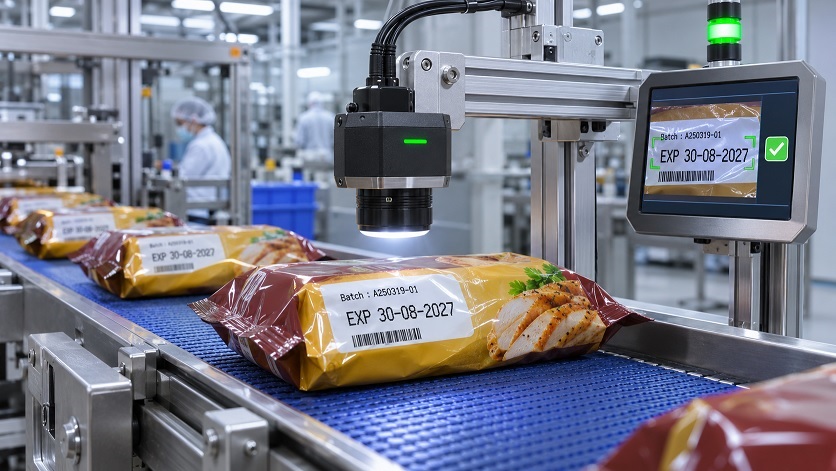
As an alternative, companies can implement a vision inspection system that uses industrial cameras and image processing technology to automatically analyze product conditions.
This system can be configured to detect various types of defects, including:
- Missing labels or incorrectly positioned labels.
- Missing product components.
- Visual defects on product surfaces.
- Irregularities in product shape or dimensions.
- Incorrect object positioning on the production line.
With automated inspection, manufacturers can identify defects earlier and reduce the risk of defective products proceeding to subsequent production stages.
4. Integrate Smart Cameras with Production Machines
Industrial smart cameras can help improve the effectiveness of quality control processes.
Unlike conventional cameras, smart cameras feature built-in image processing capabilities, allowing visual analysis to be performed directly within the device.
This technology can be integrated with automation systems, such as Programmable Logic Controllers (PLCs), to support decision-making based on inspection results.
For example, when a camera detects a product that fails to meet quality standards, the system can send a signal to activate a product rejection mechanism or alert the operator.
PT Aga Prima Engineering offers a range of Teledyne DALSA Smart Cameras and Vision Sensors, including BOA, BOA2, and BOA Spot, which can be used for various industrial visual inspection applications.
The appropriate model should be selected based on product characteristics, production line speed, and the required level of inspection accuracy.
5. Monitor Product Quality in Real Time
Another way to reduce product defects is to monitor production results continuously.
Through automated quality control systems, inspection data can be used to identify changes in product quality while the production process is underway.
For example, an increase in products with incorrectly positioned labels may indicate a problem with the labeling machine.
This information allows operators to investigate the issue and take corrective action before the number of defective products increases.
Real-time monitoring also supports the evaluation of production line performance using more objective and measurable data.
6. Improve Machine Maintenance and Calibration
The condition of production machinery has a significant impact on final product quality. Worn components, incorrect machine settings, or malfunctioning sensors can all lead to product defects.
Therefore, companies should implement a scheduled preventive maintenance program.
In addition to production machinery, automated inspection equipment also requires regular maintenance. Camera settings, lighting conditions, focus, and installation positions must be checked to ensure they meet the requirements of each application.
Proper maintenance helps maintain process stability and reduces the risk of inspection errors caused by changes in equipment conditions.
7. Analyze Defect Data for Continuous Improvement
Reducing product defects is not just about identifying defective items. It is also about preventing the same problems from happening again.
Companies can analyze inspection data to identify the most common types of defects, determine which machines require attention, and identify production processes that need improvement.
Several key performance indicators can be monitored, including the product defect rate, the number of products requiring rework, and the percentage of products that pass inspection on the first attempt.
By using this data, companies can establish improvement priorities and measure the effectiveness of the corrective actions they have implemented.
Optimize Your Automated Quality Control System with Aga Prima Engineering
Implementing automated quality control can be a strategic step for companies looking to improve product quality consistency and reduce product defects.
With smart camera and vision sensor technology, inspection processes can be carried out more systematically, helping manufacturers detect product inconsistencies at an early stage.
PT Aga Prima Engineering provides Teledyne DALSA Smart Cameras and Vision Sensors to support various industrial automation requirements, including quality inspection, component verification, and visual inspection on production lines.
With product options such as BOA, BOA2, and BOA Spot, companies can choose solutions that suit their application characteristics and operational requirements.
Looking to improve inspection efficiency and reduce product defects in your factory?
Explore the range of Smart Cameras and Vision Sensors from PT Aga Prima Engineering and consult with our professional team to find the right automated inspection solution for your production line.