
Labeling plays an essential role in manufacturing, packaging, warehousing, and distribution. A label does more than display a product name or brand identity. It can also contain barcodes, batch numbers, production dates, serial numbers, logistics information, handling instructions, and shipping destinations.
In production environments with high output volumes, printing and applying labels manually can slow down operations. Operators must check the information, remove the printed label, place it on the correct package, and repeat the same process for every product or carton.
This manual workflow requires time and concentration. It can also create inconsistencies in label placement or increase the risk of applying incorrect information to a package.
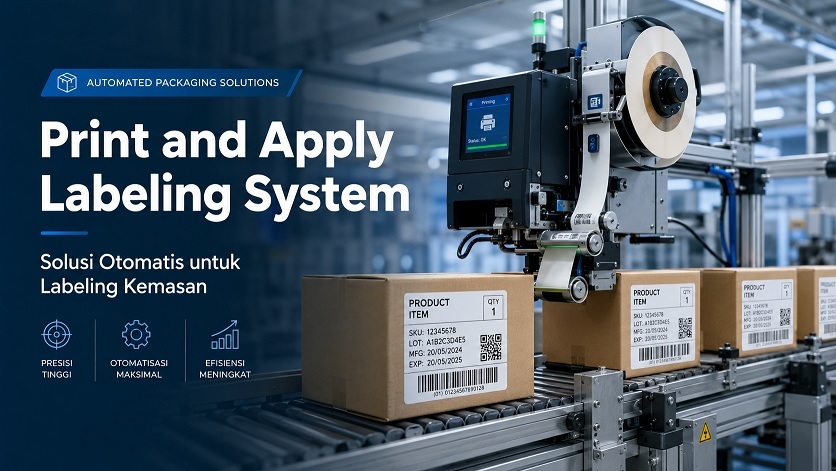
A print and apply labeling system offers a more efficient solution. It combines label printing and automatic application in a single process, allowing labels to be printed and attached directly to products, cartons, or pallets as they move through the production line.
When properly configured, a print and apply labeling system can help manufacturers improve labeling speed, reduce repetitive manual work, and maintain more consistent results across different packaging formats.
What Is a Print and Apply Labeling System?
A print and apply labeling system is an automated machine that prints information on a label and immediately applies the label to a product, package, carton, case, panel, or pallet.
Unlike a standard label printer, which only produces printed labels, a print and apply machine is equipped with an applicator mechanism. Once the label has been printed, the applicator transfers it from the printer to the designated surface.
The system can print both fixed and variable information. Fixed information may include company names, logos, product descriptions, or handling symbols. Variable information may include batch numbers, expiration dates, serial numbers, barcodes, order numbers, and shipping addresses.
Because the information can be changed for each product or production batch, the system is suitable for companies that handle multiple product variations, frequent order changes, or different distribution destinations.
Print and apply technology is commonly installed near conveyors, packaging machines, case sealers, palletizing stations, and warehouse dispatch areas.
How Does a Print and Apply Labeling System Work?
A print and apply labeling system usually operates as part of an automated production or packaging line.
When a product or carton approaches the labeling area, a sensor detects its presence. The system then receives the required label data from a computer, production database, enterprise system, label design software, or a previously stored job configuration.
The printer produces the label according to the selected format. After printing, the label is transferred to the applicator mechanism. The applicator then places the label on the specified area of the package.
The complete process takes place automatically. Operators do not need to remove each label from the printer and attach it manually.
Depending on the application, the system may use sensors to monitor label position, media condition, product presence, and applicator movement. These controls help maintain a consistent labeling process and allow operators to identify operational issues more easily.
Although the basic workflow appears straightforward, several factors affect the performance of the system. Conveyor speed, product spacing, label dimensions, packaging material, adhesive type, sensor position, and the distance between the applicator and the package must all be considered during installation.
Why Do Manufacturers Need Automated Labeling?
Manual labeling may still be practical for small production volumes. However, it often becomes inefficient as output increases.
The more products a company processes, the more time operators must spend printing, checking, sorting, and attaching labels. When label information changes frequently, the possibility of mismatching a label with a product may also increase.
A print and apply labeling system allows labels to be created when they are needed and applied directly on the production line. This approach supports a smoother packaging process and reduces unnecessary handling between printing and application.
Automation is not only about speed. Consistent label placement can also improve barcode scanning, warehouse identification, visual inspection, and product sorting.
When every label is positioned in approximately the same area, scanners and downstream equipment can detect the information more reliably. This consistency is particularly important in logistics and distribution environments where cartons may pass through automated sorting systems.
Information That Can Be Printed on Labels
A print and apply system can produce various types of information based on the needs of the company and its industry.
The label format may combine permanent content with data that changes for every product, order, or batch. Common examples include:
- One-dimensional and two-dimensional barcodes.
- Batch numbers, lot numbers, and serial numbers.
- Production dates and expiration dates.
- Product names, variants, dimensions, and quantities.
- Warehouse locations and shipping destinations.
- Logos, handling symbols, and product instructions.
This information can support product identification, inventory management, traceability, order fulfillment, and distribution.
The layout must still be designed carefully. Barcode size, print contrast, quiet zones, label position, and surface condition can affect readability. A well-designed label is not only visually clear but also suitable for scanners and automated data-capture systems.
Main Advantages of a Print and Apply Labeling System
One of the main advantages of a print and apply labeling system is its ability to perform two tasks in one integrated process. The machine prints the required information and immediately applies the label to the package.
This reduces the need to move printed labels from a separate printer to the production area. Operators no longer have to collect labels, organize them by product, and manually match them with every carton.
Another advantage is placement consistency. Once the applicator has been properly configured, the system can place labels in a similar position on each package. Consistent positioning is useful when the products will later be scanned, sorted, inspected, or stored.
The system also supports on-demand printing. Companies do not always need to keep large quantities of preprinted labels for every product variation. Label information can be generated according to the product currently moving through the line.
This flexibility can be beneficial for companies that frequently change products, order numbers, shipping destinations, or batch information.
Automated labeling also reduces repetitive manual tasks. Operators can focus on monitoring machine performance, replacing label rolls, checking print quality, and resolving issues that require human judgment.
However, the benefits depend on correct system integration. A machine should be selected based on actual production requirements rather than maximum specifications alone.
Applications for Products, Cartons, and Pallets
Print and apply labeling systems can be used at several packaging levels.
At the primary product level, labels may contain variable information directly related to an individual item. Depending on the product, this may include a serial number, product code, or manufacturing information.
At the secondary packaging level, labels are commonly applied to cartons, cases, and shipping boxes. These labels may display product descriptions, quantities, lot numbers, carton barcodes, warehouse information, and delivery destinations.
At the pallet level, labels are used to identify larger logistics units. A pallet label can help warehouses and distribution centers determine the contents, origin, destination, and status of the goods.
The system can also be configured to apply labels to different areas of the package. Depending on the machine and applicator design, labels may be placed on the top, side, front, back, or corner of a carton.
Corner-wrap labeling is useful when information needs to remain visible from two adjacent sides. It may also support scanning in warehouse environments where carton orientation can vary.
These capabilities make print and apply systems suitable for industries such as food and beverage, pharmaceuticals, consumer goods, automotive components, electronics, chemicals, logistics, warehousing, and general manufacturing.
Label Application Methods
Not every package requires the same application method. A flat carton moving steadily on a conveyor has different requirements from an irregular product, a flexible package, or a large pallet.
One common method uses a contact pad. The applicator moves toward the package, presses the label onto the surface, and returns to its starting position.
Another method is wipe-on application. In this configuration, the label is dispensed and wiped onto the surface as the product moves past the applicator.
Some applications use air assistance to transfer the label with limited physical contact. This method may be useful for certain surfaces or packaging conditions.
The right application method depends on the shape and material of the package, label size, conveyor speed, product spacing, and required label position.
Packages that require labels on two sides, corners, or hard-to-reach areas may need additional applicator configurations. A technical assessment is therefore important before selecting the final machine setup.
Integration with Production Lines
A print and apply labeling system performs best when it can communicate with other equipment and software used in the production process.
The machine may receive data from label design software, manufacturing databases, warehouse systems, order management platforms, or enterprise resource planning systems.
This integration allows the printed information to change according to the product being processed. When the product variant, customer order, batch number, or destination changes, the system can load the correct label format.
Connectivity may also allow job settings to be stored and recalled by operators. This can reduce setup time when the same packaging format is used again.
Even when the machine supports multiple communication options, integration must still be carefully planned. The company needs to define the data source, communication method, print trigger, error-handling procedure, and response when a connection is interrupted.
If label data comes from several systems, clear data-management rules are essential. The objective is to make sure that the label being printed corresponds to the product positioned in front of the applicator.
Factors to Consider Before Choosing a System
Selecting a print and apply labeling system should begin with a detailed review of production requirements.
Label dimensions are one of the first considerations. Large labels require suitable print capacity, media handling, and applicator size. The shape of the package also determines whether the label should be applied from the top, side, front, back, or around a corner.
Conveyor speed and product spacing must be measured accurately. The system needs enough time to print, prepare, and apply each label before the next product arrives.
The production environment is equally important. Dust, heat, humidity, vibration, and available installation space can affect machine configuration and component selection.
Companies should also consider the availability of labels and thermal transfer ribbons, operator interface, job storage, diagnostic functions, connectivity, maintenance requirements, and technical support.
A machine with the highest specification is not always the best solution. The most appropriate system is one that matches the packaging format, required production speed, operator capabilities, and long-term development plan of the production line.
Print and Apply PA7100 from Aga Prima
Companies planning to automate their packaging labeling process can explore print and apply solutions from PT Aga Prima Engineering.
Aga Prima provides industrial marking, coding, and labeling technologies for companies in Indonesia. One of the available solutions is the Diagraph PA7100 Print and Apply Labeling Machine.
The PA7100 is an electric print and apply system that uses servo technology to control label dispensing and movement. It is designed to support different industrial labeling applications, including product, carton, and pallet labeling.
The machine can be configured for labels placed on the front, back, side, top, or corner of a package. This flexibility allows the system to be adapted to different production-line layouts and packaging requirements.
The PA7100 is equipped with a responsive touchscreen interface that supports machine setup and operational monitoring. Integrated diagnostics provide real-time feedback from sensors, helping operators identify conditions that may interrupt the labeling process.
Its brushless servo motor controls label movement, while integrated sensors help monitor the label and media during operation. Job settings can be stored, and label formats can be received through supported communication connections.
Because every production line has different requirements, the machine configuration should be determined through a technical evaluation. Label size, conveyor direction, product spacing, production speed, package surface, data source, and installation position should all be reviewed before implementation.
In addition to print and apply labeling machines, Aga Prima offers industrial marking and coding solutions such as Continuous Inkjet printers, Thermal Inkjet printers, Thermal Transfer Overprinters, laser marking systems, and industrial vision camera systems.
A Labeling Solution Designed Around Your Production Process
A print and apply labeling system can be a strategic investment for companies seeking faster and more consistent packaging identification.
By combining variable-data printing and automatic label application, the system can support product identification, carton labeling, warehouse operations, and shipping preparation.
However, successful implementation depends on more than the printer itself. Labels, ribbons, software, sensors, applicators, conveyors, data systems, and operator procedures must work together as one integrated process.
For this reason, companies should work with a supplier that understands both printing technology and real production conditions.
To learn more about print and apply labeling systems, the Diagraph PA7100, and other industrial coding and marking solutions, visit Aga Prima at https://www.agaprima.com/. PT Aga Prima Engineering can help assess your labeling requirements and recommend a system that matches the characteristics of your production line.