
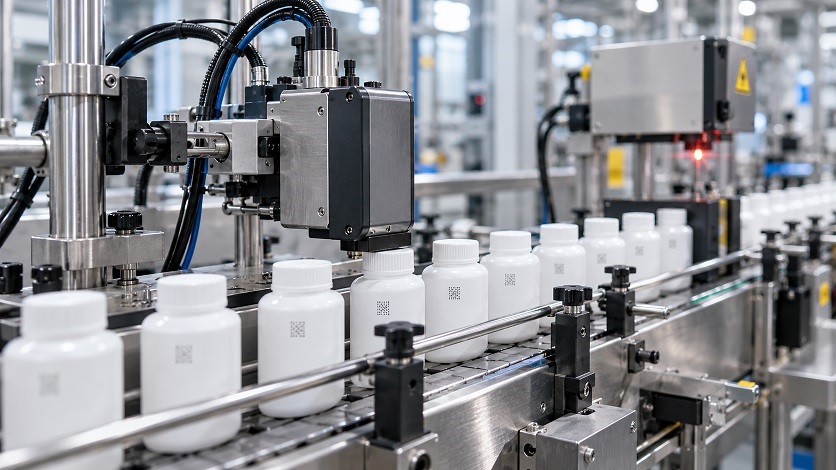
In the manufacturing industry, every product requires clear identification to support production, distribution, and quality control processes. Information such as manufacturing dates, expiration dates, batch numbers, and identification codes is essential and must be displayed on products or their packaging. To meet these requirements, many companies use marking machines as an integral part of their production systems.
Marking machines enable manufacturers to apply identification codes more quickly, consistently, and efficiently than manual methods. This technology also supports product traceability, particularly in the food and beverage, pharmaceutical, cosmetics, and other manufacturing industries.
So, what exactly is a marking machine, how does it work, and what types are available? Let’s explore the details below.
What Is a Marking Machine?
A marking machine is an industrial device used to apply marks, codes, symbols, or specific information to the surfaces of products or packaging. The marking process can be performed using various technologies, including inkjet printing, laser marking, and other specialized methods, depending on the material’s characteristics.
The information produced by marking machines typically includes manufacturing dates, expiration dates, serial numbers, batch codes, barcodes, QR codes, and product identification details. These markings help manufacturers identify and track products throughout production and distribution.
In practice, marking machines are often referred to as coding machines because their functions are closely related. However, the term “marking” covers a broader range of applications, including permanent identification on materials such as metal and plastic.
In modern manufacturing facilities, marking machines can be integrated with conveyor systems and automated production lines, allowing products to be marked without interrupting production.
Functions of Marking Machines in Manufacturing
Marking machines play an essential role in supporting efficient manufacturing operations. Beyond printing information on packaging, these systems help improve production efficiency and quality control.
1. Providing Product Identification
Every product requires identifying information to distinguish it from others. Marking machines help manufacturers consistently print batch numbers, production codes, and serial numbers, making products easier to identify.
2. Supporting Product Traceability
Product traceability refers to the ability to track a product’s origin, production history, and distribution journey. With properly assigned identification codes, companies can trace products using information stored in their production management systems.
3. Improving Production Efficiency
Automated coding reduces the need for manual marking processes. When integrated into production lines, marking machines can operate continuously at speeds synchronized with conveyor systems.
4. Enhancing Quality Control
Production codes help manufacturers identify specific product batches when quality issues arise. This information supports inspections, investigations, and more targeted product recalls when necessary.
5. Supporting Packaging Information Requirements
Many product categories are subject to specific labeling requirements. Marking machines help manufacturers print the necessary information in accordance with applicable regulations and industry standards.
Types of Marking Machines Used in Manufacturing
Several types of marking machines are available, each using different technologies and offering specific advantages. Selecting the right equipment depends on the product material, production speed, printing requirements, and operational budget.
1. Continuous Inkjet (CIJ) Printer
Continuous Inkjet (CIJ) is a printing technology that uses a continuous stream of ink to produce identification codes on product surfaces.
This technology is widely used in high-speed production environments because it can print while products move along a conveyor. With the appropriate ink formulation, CIJ printers can mark various materials, including plastic, glass, metal, and flexible packaging.
CIJ printers are commonly used to print expiration dates, batch numbers, and small-character production codes.
2. Thermal Inkjet (TIJ) Printer
Thermal Inkjet (TIJ) technology uses ink cartridges equipped with heating elements to generate tiny ink droplets that form text, codes, or images.
TIJ printers are known for their high-resolution printing capabilities and relatively straightforward operation. They are suitable for printing text, barcodes, and product information on various packaging materials.
Because many TIJ systems use cartridge-based technology, ink replacement can be quick and convenient. However, selecting the appropriate ink remains essential to ensure compatibility with the printing surface and the required durability.
3. Laser Marking Machine
Laser marking machines use focused laser energy to create marks on material surfaces without requiring ink.
Depending on the material and marking method, this technology can produce durable, long-lasting identification marks. Laser marking is widely used for printing serial numbers, production codes, logos, and other identification details.
Common laser technologies include CO2 lasers, fiber lasers, and UV lasers. Each type offers different characteristics and is suitable for specific materials and applications.
Laser marking systems are used across various industries, including packaging, electronics, automotive manufacturing, and industrial component identification.
4. Thermal Transfer Overprinting (TTO)
Thermal Transfer Overprinting (TTO) is a printing technology that uses heat to transfer ink from a ribbon onto packaging materials.
This technology is commonly used for flexible packaging applications, including plastic films and food packaging. TTO systems can print manufacturing dates, barcodes, batch codes, and additional product information.
Selecting the correct ribbon and machine settings is essential for achieving consistent print quality.
Industries That Use Marking Machines
Marking machines are widely used across industrial sectors because product identification requirements extend beyond a single manufacturing category.
In the food and beverage industry, marking machines print expiration dates, production codes, and batch information on bottles, cans, and plastic packaging.
Pharmaceutical manufacturers use marking technology to support product identification and traceability throughout distribution. Meanwhile, cosmetics companies rely on coding equipment to print manufacturing information on product packaging.
In the automotive and electronics industries, laser marking is frequently used to apply serial numbers and identification codes to specific components.
With such diverse applications, marking machines have become an essential supporting technology in modern manufacturing operations.
How to Choose the Right Marking Machine
Before purchasing a marking machine, companies should carefully evaluate their operational requirements to ensure the selected technology matches their production environment.
First, consider the type of material being marked. Plastic, glass, metal, and paper surfaces have different characteristics and may require specific printing technologies or ink formulations.
Second, evaluate production speed. High-volume manufacturing lines need marking equipment capable of keeping pace with product movement while maintaining code readability.
Third, determine the information that needs to be printed. Simple date coding has different requirements from printing barcodes, QR codes, or serial numbers containing variable data.
Companies should also consider operating costs, maintenance requirements, spare parts availability, and technical support from their equipment supplier.
Selecting the appropriate marking machine can help maintain production continuity while optimizing long-term operating costs.
Aga Prima Engineering: A Trusted Marking Machine Supplier for Industrial Applications
For companies seeking reliable marking solutions, PT Aga Prima Engineering provides industrial coding, marking, and labeling technologies designed to support a wide range of manufacturing requirements in Indonesia.
Since 2011, Aga Prima Engineering has supported industrial operations by supplying coding machines and inspection systems tailored to different production environments.
The company offers various marking technologies, including Continuous Inkjet (CIJ) Printers, Thermal Inkjet Printers, and Packaging and Industrial Laser Printers.
These technology options allow manufacturers to select suitable marking systems based on product characteristics, packaging materials, production speeds, and operational requirements.
Beyond supplying equipment, Aga Prima Engineering provides technical consultation, installation services, operator training, and after-sales support. These services help manufacturers implement marking technologies effectively within their production processes.
With its experience in industrial coding and marking, Aga Prima Engineering serves as a technology partner for businesses seeking to improve production efficiency and maintain consistent product identification.
Conclusion
Marking machines are essential industrial tools used to apply identification codes, production information, and other markings to products and packaging. These technologies support operational efficiency, quality control, and product traceability across manufacturing industries.
Different types of marking machines, including CIJ, TIJ, laser marking, and TTO systems, offer distinct advantages depending on their applications. Therefore, selecting the right equipment requires careful consideration of material compatibility, production speed, print quality, and operating costs.
Looking for a reliable marking machine for your manufacturing operations? PT Aga Prima Engineering offers a comprehensive selection of industrial coding and marking solutions, supported by professional technical services to help businesses identify the most suitable technology.
Visit www.agaprima.com or contact the Aga Prima Engineering team to discuss your industrial marking requirements and find the right solution for your production line.